🎬 Video summary and slide deck available at the end of this article.
In early 2025, a small French e-commerce business — let's call them Atelier Nord — made the decision many founders dream of: expanding into Germany. They sold handmade home goods. The German market was ten times the size of their existing customer base. They translated the website, added German shipping options, and launched a Meta ad campaign targeting German consumers. Eight weeks later, a registered letter arrived.
It was dense German legal text, four pages long. Near the top, a claim for €1,200 in legal fees. At the bottom, a deadline: ten days. Atelier Nord had received an Abmahnung — a formal cease-and-desist — from a German competitor, filed through a specialized law firm that had systematically monitored French e-commerce entrants into the German market. They had identified three compliance violations.
Atelier Nord tried to handle it internally for a few days, then realized they needed a German lawyer. By the time one was engaged, the deadline had passed. The sender filed for a preliminary injunction. The injunction was granted. German sales halted. Total cost: approximately €3,500 in legal fees, two weeks of halted operations, and a poisoned entry into their most promising new market. Every one of those compliance gaps would have cost a few hundred euros to identify and fix before launch.
Disclaimer: This article is for informational purposes only and does not constitute legal advice. If you have received an Abmahnung, consult a qualified German lawyer immediately. Regulations and enforcement practices may change over time.
Before going further, one distinction matters enormously — because confusing the two leads to the wrong response.
| Abmahnung | Regulatory Fine (CNIL / BfDI) | |
|---|---|---|
| Who sends it | Competitor, law firm, consumer group | Government authority |
| Legal basis | Civil law — UWG, BGB | GDPR, TDDDG, national law |
| Deadline | 7–14 days to respond | Months to years |
| Injunction risk | Court order in 24–48 hours if deadline missed | No |
| Financial exposure | €1,000–€30,000 in legal fees | Up to €20M or 4% of global turnover |
| Public record | Court records if litigated | Published decisions (e.g., cnil.fr) |
Both are real risks. But an Abmahnung moves faster, comes from unexpected directions, and can halt your business operations within days of the deadline passing.
In Germany, any party with a legitimate legal interest can send an Abmahnung — a formal cease-and-desist letter — to a business they believe is violating the law. The system was designed as a pre-litigation mechanism to resolve disputes without courts. It became something else.
A network of law firms — informally called Abmahnanwälte — has built entire practices around systematically identifying non-compliant websites and sending templated letters on behalf of competitors, industry associations, or other qualified entities. According to industry estimates, Germany sees approximately 200,000 to 300,000 Abmahnungen filed per year across all legal domains. The website-related share has grown steadily as e-commerce expanded and compliance requirements became more complex.
This is not a fringe legal tactic. It is a structured, profitable industry operating within German law. And its preferred customer is the small business.
The economics are straightforward. A templated Abmahnung costs a specialized law firm very little to produce. The recipient, however, must engage a German lawyer, assess the claim, negotiate the response, and fix the underlying issue — regardless of whether the claim has merit. A €2,500 settlement feels painful but manageable to a small business. Litigation feels existential. Abmahnanwälte know this, and they price accordingly.
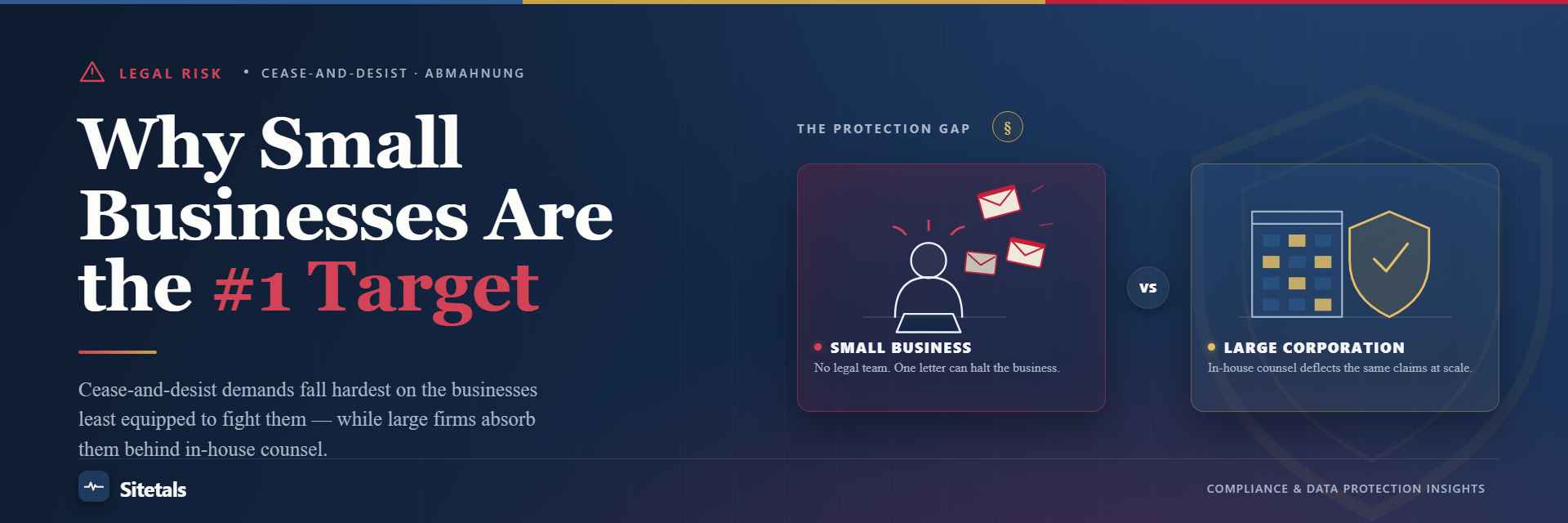
Large companies contest Abmahnungen routinely. They have in-house counsel, established relationships with German law firms, and the institutional confidence to push back on overreaching claims. Small businesses typically don't have any of those things — which is why they settle more often, settle faster, and settle on terms that favor the sender.
| Metric | Estimate |
|---|---|
| Annual Abmahnungen in Germany (all types) | 200,000 – 300,000 |
| Average legal cost for recipient to respond | €1,000 – €3,500 |
| Cost if case goes to preliminary injunction | €5,000 – €15,000 |
| Cost of full litigation | €10,000 – €30,000+ |
| Time lost managing the dispute | 2 – 6 weeks operational disruption |
Reimbursable opposing-lawyer fees for a typical competition-law Abmahnung run about €850–1,200 net (RVG, Gegenstandswert €10,000–20,000); your own defense costs come on top, and court escalation can exceed €6,000 in fees.
The cost of finding your compliance gaps first:
| Action | Typical Cost | Timing |
|---|---|---|
| Compliance scan (Sitetals) | Free | Before launch |
| Full paid compliance report | From €49 | Before launch |
| German lawyer to fix compliance | €500–€2,000 | Before launch |
| Total proactive cost | Under €2,000 | Your timeline |
| Legal response to Abmahnung | €1,000–€5,000 | 7–14 days deadline |
| Court escalation if deadline missed | €5,000–€15,000 | 24–48 hours |
| Full litigation | €10,000–€30,000+ | Months |
| Total reactive cost | €1,000–€30,000+ | Not your timeline |
There is no way to fully eliminate the risk of receiving an Abmahnung once you operate in Germany. Even compliant businesses occasionally receive opportunistic or exaggerated claims.
But there is a meaningful difference between a business with visible compliance gaps and one with a clean compliance posture. The first is an easy, low-cost target. The second is a harder case to pursue — and Abmahnanwälte, like any rational actors, pursue easy cases first.
See what Abmahnung response looks like in practice if you've already received one — and see our France vs. Germany enforcement comparison to understand the full risk picture across both markets.
Already received an Abmahnung? See our step-by-step response guide: Received an Abmahnung? Here's What to Do in the Next 14 Days
Check your compliance before a competitor does it for you.
A free Sitetals scan identifies key compliance gaps — in under 60 seconds.
Scan your website nowAre Abmahnungen only for e-commerce sites?
No. Any website that targets German users can receive an Abmahnung — including B2B sites, service business websites, blogs with affiliate links, and SaaS platforms. Impressum and cookie consent obligations apply to virtually all commercial websites.
Can I prevent an Abmahnung?
You cannot guarantee you'll never receive one. But you can significantly reduce your risk by maintaining a clean compliance posture. Regular compliance checks, keeping your legal documentation up to date, and addressing any identified gaps promptly make your site a far less attractive target. Prevention is always cheaper than response.
What should I do before launching in Germany?
Run a compliance scan of your website before you invest in marketing, inventory, or logistics for the German market. Catching compliance gaps before launch costs a fraction of what it costs to fix them under the pressure of a 7–14 day Abmahnung deadline.
How the Abmahnung system works, why foreign businesses are caught off guard, and what to check before entering the German market.
How the Abmahnung system works, why foreign businesses are caught off guard, and what to check before entering the German market.